
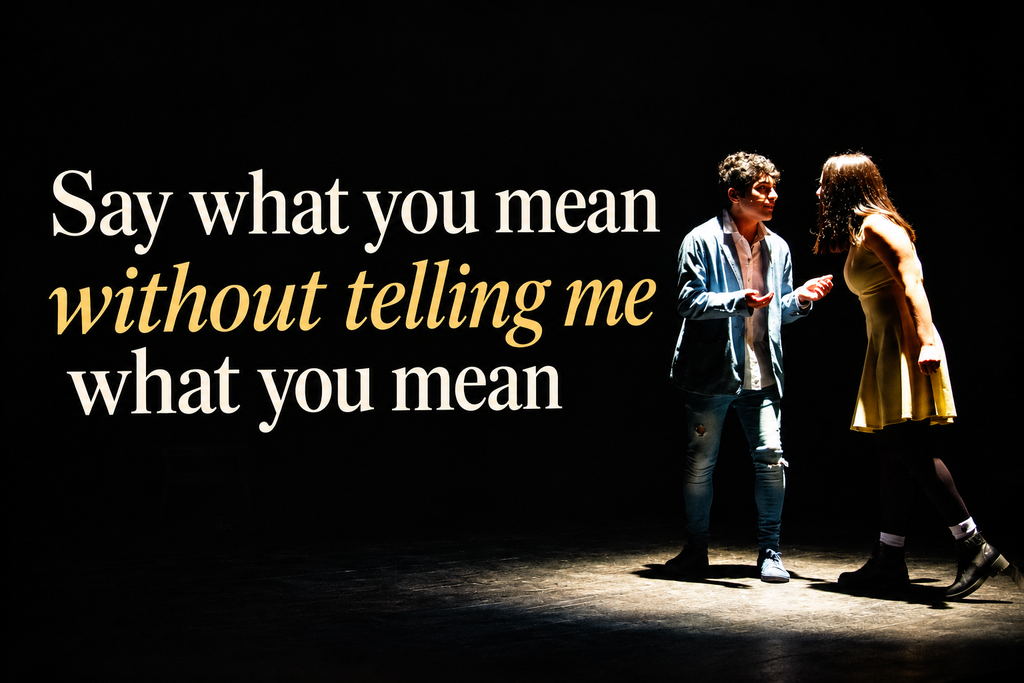
Before I ever wrote a novel, I wrote plays. Before that, I was on stage speaking other people’s words as an actor.
Turns out, theatre gave me one of the best possible educations in dialogue. So I’m going to walk through a series of posts about how playwriting and theatre work can inform your dialogue skills.
The first big thing to consider is this:
Dialogue is key to character.
In long-form fiction, you can expand on dialogue with internal thought. You can explain what a character meant, or what they felt, or what they wished they had said. On stage, most of that internalisation doesn’t exist unless you employ devices such as monologues or asides, where a character directly addresses the audience and lets them in on their interior world. But these devices can also stop dramatic action in its tracks, so most of the time the dialogue itself has to carry an enormous amount of the story.
The actor stands in front of an audience with the words.
And they aren’t just any random words. They are specific. A playwright has poured hours of skill and thought into choosing these particular words.
The actor’s job is to find what is underneath them.
Actors make a study of a playwright’s text, harvesting hints from every sentence. Why does the character say that? Why now? What do they want? What are they trying to make happen?
An actor has to find the intention, the motivation and the truth of every. Single. Line.
So dialogue is one of our great keys to understanding a character’s internal world. But it does something else as well.
Think of dialogue as one person seeking to have an impact on another.
Theatre people spend literally hours in rehearsal talking about this. You’ll hear an actor say something like, “With this line, I want to [insert active verb] you.”
That verb depends entirely on the situation and the character’s motivation. I might want to press you, protect you, harass you, demean you, command you, elevate you, confuse you, judge you, frighten you or warn you. There are thousands of possibilities.
And this is a useful old actor’s exercise that fiction writers can steal.
Take a line of your own character’s dialogue and interrogate its intent. Instead of asking only what the speaker wants, ask what effect they want their words to have on the other person.
What are they trying to do to them?
Actors often call these action words. When working on a scene, they may assign an action to a particular line or section of dialogue.
Take this completely ordinary line:
“Are you going to the shops again?”
On its own, it looks like a simple request for information.
But is it?
There could be any number of intended impacts behind that sentence. It depends entirely on the character and the situation. But in useful dramatic dialogue, there will generally be something going on beyond the casual inquiry. (Theatre people hate rambling words and will seek to demolish them with a big red pen.)
Maybe the character wants to accuse. Or badger. Or inveigle. Perhaps they want to prompt, shame, dismiss, squeeze or grill.
“Are you going to the shops again?”
Try saying it with each of those actions in mind.
The words don’t change.
But everything else does.
And notice that this is not about how the character feels while speaking the line. It’s about what the character is trying to make happen in the person hearing it.
It is Character A’s action upon Character B.
That distinction can be enormously useful when you’re writing a scene that feels flat and you can’t quite work out why. Go through the dialogue and ask: What is this character doing to the other character with this line?
If the answer is “nothing much”, you may have found the problem.
Now imagine your character’s intention is to accuse another character of wasting time. How do you make sure the reader understands that intention?
Sure, you could explain it around the dialogue:
“Are you going to the shops again?” I asked, daggers in my eyes.
But what if the accusation is already in the words?
“Are you swanning off to the shops again?”
No explanatory tag required. Swanning off does the work. You have a punchier line of dialogue and, more importantly, the character’s intended action on the other person is already embedded in the language.
That’s what I mean by making dialogue do something rather than explaining afterwards what it was supposed to do.
There’s much more to say about what playwriting and acting taught me about dialogue: writing playable words; writing authentic vernacular; keeping voice separate from vernacular; fine-tuning the pace of an exchange; finding tension, conflict and tipping points.
I’ll get to those in future posts.
But for now, take one scene from your own fiction and try the actor’s trick.
Don’t ask only, What does my character want to say?
Ask:
What are they trying to do to the other person by saying it?
Comments are closed, but trackbacks and pingbacks are open.